Surfer's Challenge
- RUN Magazine

- Feb 26
- 11 min read
Local East London runner Bob Norris takes a look back at the Discovery Surfers Challenge and how far it's come, a race that's embedded itself in running folklore, both in the Eastern Cape and beyond, with a few words from race director Neville Wilkins and past winner Danny Biggs.
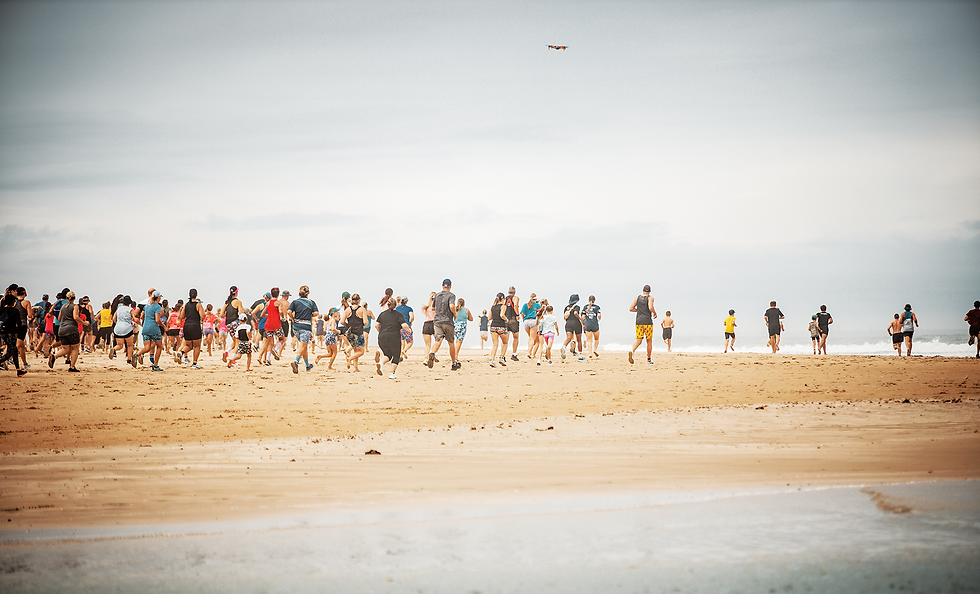
The annual Surfers Challenge in East London is a race like no other in Southern Africa, and with little rivalry anywhere on the planet. It is a race of different sporting cultures, and it all comes together on one day annually, normally in February, governed by the Indian Ocean tides.
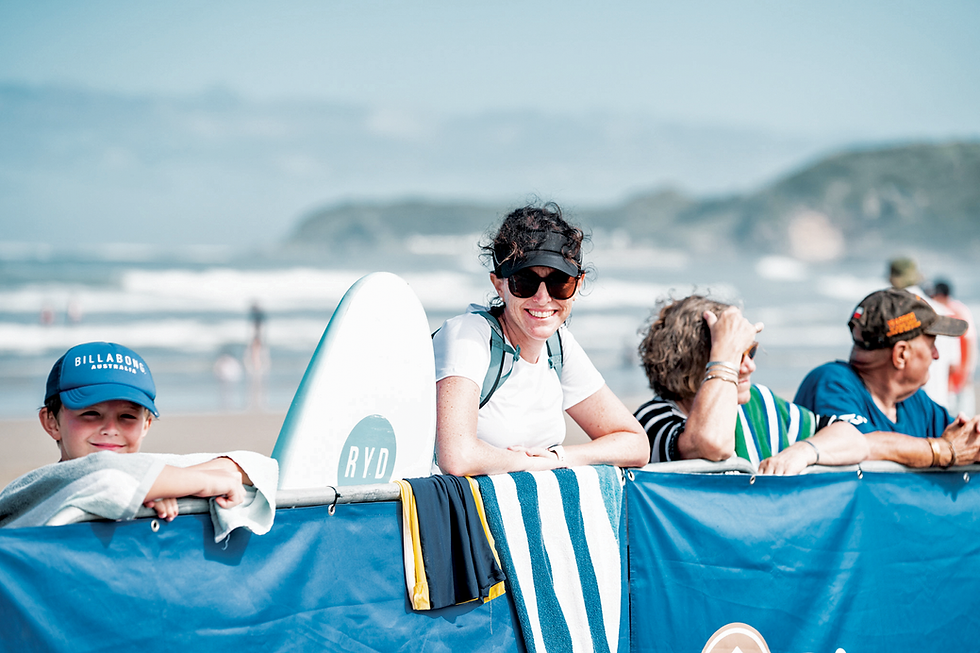
On that day, there is a great movement of runners, walkers and paddlers along the coast in a westerly direction. Hugging the sidelines of the route from Kwelera River Mouth to the East London Surf Lifesaving Club at Nahoon are as many spectators, maybe more, as the three to four thousand competitors.
The race is sponsored by Discovery and has, with their backing, developed into a major event on both the local and national sporting calendars, but it was not always that way.

LAYING DOWN A CHALLENGE
In 1974, friendly banter in a popular local watering hole, affectionately known as "The Fin", resulted in the launch of this now legendary event on the Eastern Cape sporting calendar.
A week earlier, a team of Buffalo Road Runners had defeated a spirited and lively team of surfers at an annual road relay from King Williams Town (now Qonce) to East London. The Surfers, never short of self-belief, thought the tables might be turned on a different surface to that of tarmac, something that would be closer to their natural habitat - in other words, all things beach.
No one could have predicted that the "laidback' surfing community would play a pivotal role in revolutionising running in the province.
Runners who were on the lookout for new challenges were in the minority. but there were enough who loved the idea, and so the Surfers Marathon over 16+ kilometres was born. The first race did so much to create interest and appeal that it became an annual event. Only the most optimistic locals would have predicted that 50 races later it would still be going strong, and indeed growing through inspiration and years of innovation.




ALL THINGS BEACH
The route, from day one, encompassed a narrow start above the beautiful Kwelera River Mouth - a surfing Mecca in its own right and often referred to as "Yellow Sands", the name of the campsite across the river. The narrow start endures for about 800m, before runners take on one of three drops, of one or two metres in height, to the lapping waves below. All the while they are jostling with fellow competitors as they alight onto a course with a new underfooting of shingle, sand, rocks, pebbles, shells, twigs, driftwood and whatever else the ocean churns up. The ever-changing coastline always holds secrets and offers up surprises. At the start the runners are spoilt with the view of the paddlers way down and out yonder, though all the while in sight, as they make their way towards ever deeper waters. The contrast is lost on
neither party.
The course now meanders past Sunrise-on-Sea and Rainbow Valley, both beautiful and yet so different, even though a short distance apart.
The Gonubie River is close, though the terrain is tough, probably the toughest of the foot race. The first river crossing (of the Gonubie) is the more lively of the two on the route and many use the ropes provided to assist them as they wade across. Emerging on the Gonubie side of the river, the runners are now sent off the beach and onto a road behind the majestic sand dune, which dominates the setting. From there they're marshalled to a fast section down to the Gonubie Hotel, where the largest crowds congregate. It is like Drummond on the Comrades route, only even more interactive.
The reason for the detour dates back to 2010, when the severity of the tides were such that running under the boardwalk became impossible. It was a defining year for Surfers, a race that would never be quite the same.
It was also the year that the 2003 Two Oceans Marathon winner Mluleki Nobanda, a police sergeant from the rural areas of the Transkei, won the race. He was also second at Two Oceans in 2004 and 4th in 2008. His Surfers time was slower than predicted due to the on-course conditions, and he never came back after his experience with the current in the river mouth, which was stronger than the norm. His home in Libode, a long way from the sea, had not prepared him for this rush of tide. It was undoubtedly the toughest of years.
There are four-plus kilometres of tar in the seaside suburb of Gonubie and it is populated by wall-to-wall spectators in comfy chairs, on blankets, under umbrellas and gazebos taking inspiration from those who pass.
Towards the end of beautiful Gonubie, the runners pass German Bay and then venture onto an over- populated and notorious pathway down to the beach at Eastward Ho. Thereafter follows approximately six kilometres of sand, some soft, some firm and declared "a republic" by a man named Carl, who documented the musselcrackers here most mornings until his passing. The bird populations abound, except on this day when runners, walkers and paddlers dominate. And if a runner sees an otter they are not hallucinating.
Bonza Bay and the Quenera Lagoon is the next inhabited stretch of beach with fantastic support and mystical sand dunes both on the approach to Quenera Lagoon and along the full distance to the Nahoon River, where a final river crossing awaits just a few hundred metres from the finish.
The first couple of races ended at Nahoon Corner, but soon found a set finishing point on Nahoon Beach in front of the Surf Lifesaving Clubhouse. The race now has three distances on offer, all starting at different venues - the original 17.5km Challenge at "Yellows", the 11km at Gonubie, and the 5km beneath the Blue Lagoon Hotel - but all still finish at Nahoon.



ROLL OF HONOUR
The initial race in 1974 attracted 26 enterprising and adventurous enthusiasts. Despite the hype of surfer versus runner, it was a runner who took the honours in the initial race - but he was no ordinary runner. Kenny Wilkinson was an outstanding athlete at various distances and on terrains such as cross country, track, road, beach and bush. He had earned himself many Comrades silver medals as a member of Buffalo Road Runners, was a great cross country runner and commanded respect throughout the land. Now in his 80s and living in Knysna (where he once organised the Knysna half and full marathons), Kenny was invited to run the 2020 event - only his second Surfers.
Rob Joiner, a man of similar ilk, won in 1975 and again in 1977. He ran Surfers again this year in celebration of its 50th edition.
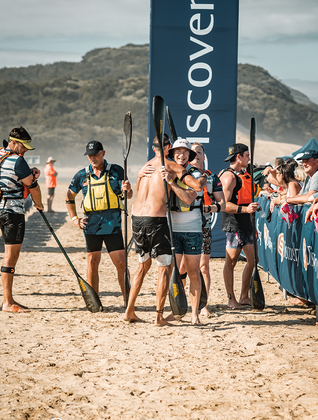
After a few years, the paddlers of East London decided they wanted to join the race, and a category was created for them. It has been a successful addition and embraced by all, although weather conditions have occasionally diverted the paddlers from a head-to-head with the runners.
Many household names in running circles have graced the Challenge since the earliest days, while several top paddlers in South Africa (including Olympians) have also taken on the elements and captured the imagination of the large number of spectators.
Winning times for runners were in the 63- to 69-minute bracket until Danny Biggs, a gold medallist at both the Dusi Canoe and Comrades marathons, topped the podium in 1985. The following year, with a better course knowledge, he took his winning time down to 60:13 (from 67:07 the year before). A year later he recorded 61:01, and a year later still, Thabang Baholo became the first black man to win Surfers in 61:19.
Biggs was a special guest at the 2025 Surfers Challenge, commanding much respect and enjoying many a trip down memory lane.
In the 1980s, the question on every enthusiast's lips was, "can the 60-minute barrier fall?" It was answered in 1989 with an affirmative and dramatic "yes it can". The late Mzwandile Shube, a former SA Junior Half Marathon Champion, broke the 60-minute mark as he romped home in a superb 55:40 aided, admittedly, by a strong following wind and silted rivers.
Regardless, Shube was in a class of his own when in full flight, and weather has of course impacted every single result in this coastal meander.
Despite Border Athletics not always understanding the hunger of runners to conquer Surfers, there are many of Border's finest who have used their talent and bravery to overcome two serious river mouths and feature prominently in the results.



In 2025, the 17.5km was won by Keegan Cooke from Nelson Mandela Bay. He arrived with his father, brother and sister to compete. He first ran the race as a 12-year-old and is now a Surfers champion.
Makaya Masumpa is a folk hero in the greater Buffalo City and has run many Surfers, but cannot be sure just how many. He started when he was a tad over 18 and he is now 58 years old and has won the race twice.
Great performances were also delivered by Sipho Majambozi and the late Michael Scout, who was a SA Marathon Champion. They recorded wins of 59:58 and 59:19 respectively in 1992 and 1993.
ULTRA STARS
Several top Comrades Marathon winners and gold medallists have also run Surfers - despite a commonly held belief that such men and women would choose to stay clear of a surface of sand, rocks and shingle, and the crossing of two rivers.
Gordon Shaw, who beat Bruce Fordyce at the Buffs Marathon in 1983 only to come second to him three months later in Comrades, had won Surfers that same year. Shaw was also joint winner with Rob Joiner in 1978.
The Shaw - Fordyce duals encouraged Fordyce himself into accepting a challenge to run Surfers, resulting in him having since completed ten or more as a guest runner.
Alan Robb, who won Comrades four times prior to the Fordyce era, has also run Surfers on numerous Occasions since settling and retiring in Port Alfred. Shaun Meiklejohn, with 10 Comrades gold medals and one win, has also became a regular on the run into Nahoon Beach, finishing up front and well ahead in his age group.




Caroline Wostmann, who won both Two Oceans and Comrades, is the most prominent female ultra marathon winner to have entered Surfers. She ran the same year that Fordyce, Meiklejohn and Robb were in the field, along with Hanlie Botha and Myrette Brink, both of whom have been awarded South African colours. It was as star-studded a field as ever assembled.
Yolande MacLean, who has nine Comrades gold medals to her credit, won Surfers in 2015 and has finished third twice. Stephanie Smith, another Comrades gold medallist, has finished on the podium at Surfers too. She has also paddled it with her husband.
Colleen Lindeque (now De Reuck) is undoubtedly the most talented and fastest woman ever to run and win the race. The multiple Olympian, now resident in the USA, blew the field apart when she arrived unannounced in 1984. Her brother Colin won the men's race that year.
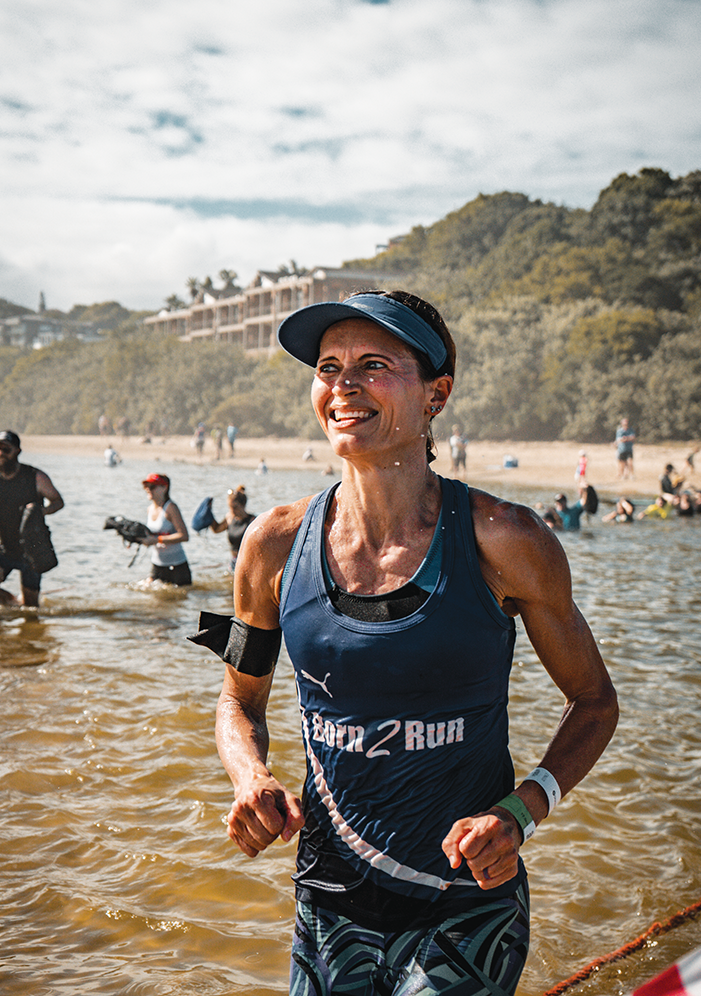
The most prominent women competitors have been Hanlie Botha of East London and Myrette Brink (nee Filmalter) from Pretoria. Both are multiple winners and their rivalry has indeed been a feature of the race in recent years. Botha won again this year and now has 11 wins to her credit. The nearest to that feat, male or female, is three wins.
Lizanne Holmes, another star runner across distances from 10 to 56km and a record holder over many, won Surfers in 1992 and 1993.
Local surfers continue to run the race, although many paddle. The most impressive over time have been Colin Hall (with nine wins in the category), Andrew Carter, Dave Malherbe, Peter Venter, Neil Henderson and Gordon Harmer. Prominent paddlers have included Hennie Roos, Stevie Woods, Brendon Thompson, Andrew Carter, Bevan Manson and Richard von Wildman. Henderson this year ran his 43rd Surfers and the next morning ran the Buffs marathon to qualify for his 10th Comrades, which he did, although he did say "it wasn't pretty".
Still going strong from the original surfers-turned-runners are a special group that includes Dougie Kunhardt, the only runner to compete in every Surfers to date, although reduced now to the 11km which he walked in the company of many a compatriot. In the aftermath of this year's race he has had a hip replacement and many will be hoping he makes it to the start in 2026.
There are many other long-time servants of the race who will be documented in what it is envisaged will become a coffee-table book in the aftermath of 50 years. Included would be members of families bearing the name of such as the Pollock, the Bradfield, and long-time race director Neville Wilkins. A project for a South African race much loved in the Eastern Cape and beyond.
IT'S A UNIQUE COURSE
From race director Neville Wilkins
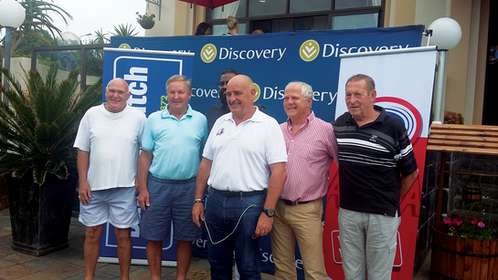
I have organised the Surfers for the past 40 years, but could not do this without the committee behind me. They've kept me on the right track. Discovery has been our anchor sponsor for the past 20 years and through their support we've been able to take this race to the next level. Last year marketing agency DigitlSky came on board, and they've helped us grow our entries. We had 3300 participants this year, and our record is 3800. I always tell people that this race is to East London what Comrades is to Durban and Two Oceans is to Cape Town.
The only downsides to the race getting bigger is that it's stopped me from participating myself due to the increased responsibilities.
In the early days, when I was into running Comrades and Two Oceans, we used to run out to the start and then run the Surfers. On some occasions we'd stop at the Gonubie Hotel for an ice-cold beer. One race I remember having to send out a search party because a wife couldn't find her husband. We searched in vain for our missing runner until one of the committee members suggested we drive out to the Gonubie Hotel. Well I don't need to tell you who we found in the bar...
Special memories include those of my father Don, who for 25 years, until he passed away, would fire the pistol to start the main race. Then there have been all the Comrades stars who have come down to run this race, like Alan Robb and Bruce Fordyce.
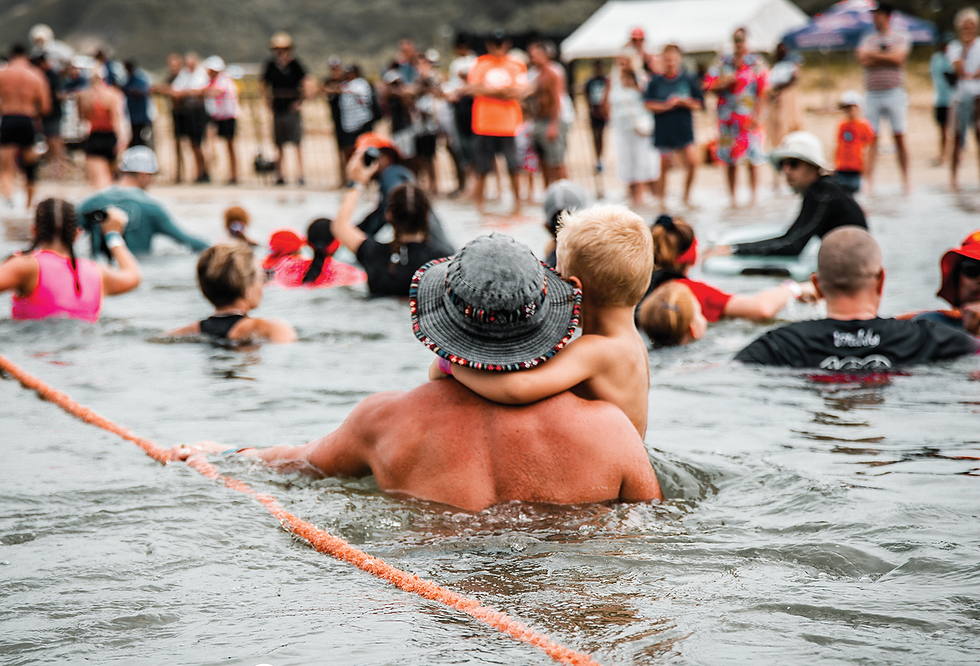
It's a unique course; it's not a road race nor a trail run. Most athletes tell us that this is equivalent to a 21km road race. Another big factor is that you need to cross two rivers. These are manned by professional lifeguards, and we also have ropes at both rivers to assist runners with the crossing. It's why this race is so dependent on the tide. Some years we've misjudged the tide and have had to spend long hours assisting runners across the last river.
In the old days, the challengers would join us for a beer at Buffs Club or the Old Dolphin Hotel. Now we have runners saying that they can't do the Surfers because they want to run Two Oceans. This is part of the reason why we introduced the 10km option. I took a lot of flak from the diehards for that.
Our finisher's t-shirts are much sought after and are worn with pride. You only get one if you complete the race in the allotted time. That's a longstanding tradition and one I have vowed to uphold for as long as I'm around. For our 50th this year, we also gave out medals to everyone who finished the 17.5km and 10km races. This is only the second time that medals have been handed out - the last time was when the race turned 25.
THERE'S A WONDERFUL SPIRIT
From past winner Danny Biggs
My memories of my Surfers Challenges in the 1980s - when I won the race three times, flew to four Comrades gold medals and took top spots at the Dusi Canoe Marathon are that they were fast, rather easy and lots of fun. I was back for the 2025 edition and for me it was slow, tough and a slog of note just to finish without too much walking! I stopped doing competitive sport quite abruptly when I could no longer train properly and I guess I never made the transition to social runner. In the 80s I was going all- out for an elusive Comrades win, so was always very fit for the race.
What has remained the same is that a wonderful spirit prevails in abundance before, during and after the race. The Surfers is an epic combination of enjoyment, friendliness, toughness and beautiful nature not easily found in any other race.