Keith Boyd: Cape to Cairo

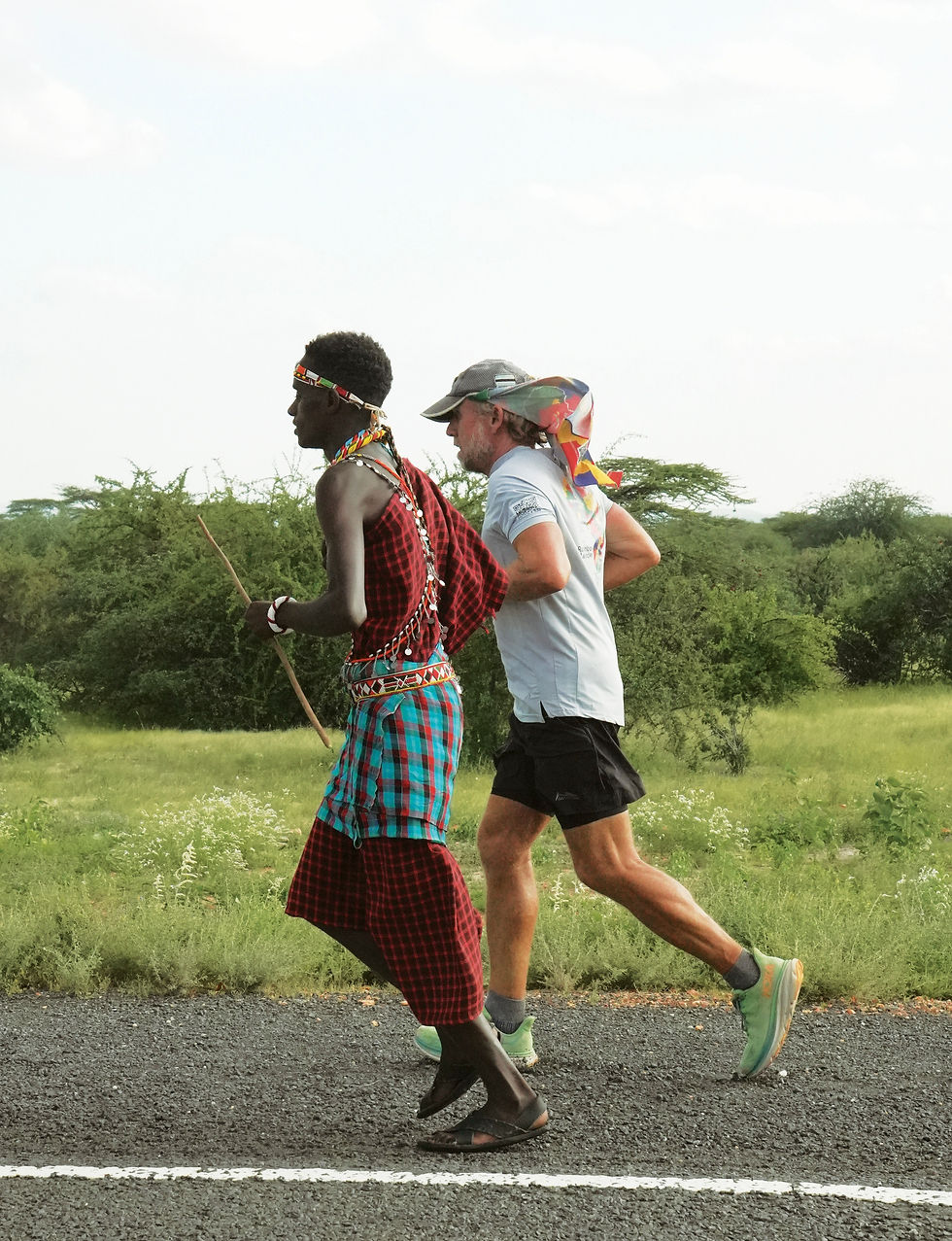
In what he describes as a journey of heart and hope, entrepreneur and social activist Keith Boyd ran 11 000km across the length of Africa – and into the Guinness World Records for the fastest time between Cape Town and Cairo on foot – to raise awareness for his youth pro-democracy foundation, Rainbow Leaders. We asked the 58-year-old with a genetic heart condition to tell us more about this audacious challenge.
Keith, what sparked the idea to run from Cape Town to Cairo in an attempt to break the Guinness World Record for the journey?
I'm an experienced entrepreneur, CEO and investor in Africa's telecomms, property, tourism and power sectors. I'm now also a socio-economic activist and social-impact investor. I started an NGO called Rainbow Leaders in 2017 in order to inspire young people to elect great leaders, and to hold them accountable. Good leaders are the only way that we will attract the levels of investment we need in order to grow our economy faster than our population – a mathematical prerequisite in order to reduce poverty and inequality.
I realised that we needed a platform to be able to better share the motivation and method behind Rainbow Leaders and our youth-focused pro-democracy and anti-poverty work. It had to be an audacious, African-based challenge, achieved by an all-African team, in order to stand the best chance of attracting attention to our mission.
Has running always been a part of your life?
I used to travel very frequently on business, and I could always fit a pair of running shoes into my cabin bag. So running became my go-to exercise in order to help me manage stress. I've run in some weird and wonderful cities on my travels, and it is a great way to get to know a little more about your destination, and the people who live there.
I found that I needed to train for a goal, so entering occasional marathons forced me to stick to a training plan – no matter the weather, or my travel or work schedule. Running marathons teaches you that allowing yourself to make excuses to skip training sessions as you build up to an event will cause you a lot of pain on race day.
Give us some insights into how you prepared for your mammoth expedition across Africa – physically, mentally and logistically. How long did it take to put it all together?
I decided to try and break the Guinness World Record for running from Cape Town to Cairo in late February 2023. The initial plan was to train for six months and start the run from Cairo in September. However, the outbreak of civil war in Sudan forced us to start the run in Cape Town in July. I therefore had only four months to prepare, so I started the expedition injured and undertrained.
In that four-month training period, I found and appointed the key people I would need to support me, and we purchased the equipment for the expedition. Were we ready at the start of the journey in Cape Town? Absolutely not. But we were fully prepared by the time I got to Cairo almost 10 months later!
How did you come to decide on your route?
We spent many hours working out a route that would best balance what we were trying to achieve at Rainbow Leaders, avoid the worst of the war in Sudan, and still allow me to break the 26-year-old Guinness World Record. The chosen route simply had to take a lengthy easterly detour through Soweto, the scene of the youth uprisings in 1976, which had dealt such a hammer-blow to the foundations of the apartheid state.
What sort of support structure did you have in place for the journey, which saw you cover 11 000km across nine countries in 301 days?
We started the expedition with two vehicles, and a crew of three. Once we hit the equator in Kenya, and facing the very difficult border crossings and civil wars in Ethiopia and Sudan, we went down to one vehicle. At various stages of the journey, I had only one support person, but I had to have a team of eight for two weeks as we navigated our way through the worst part of the civil war in northern Ethiopia.
How did you cope physically across such an endurance challenge? Did you build in time for rest and recovery? Did you have a specific nutrition plan that kept you going over 10 months on the road?
There were no scheduled rest days, but I did take one day off from running on day 126, when we had to repair and repack the lone vehicle, in preparation for the next 5 500km stretch through war zones and the Sahara Desert.
I took protein supplements, probiotics and iron tablets – but ate nothing more special than what we found along the way. Fresh bread, beans, local meat, fruit, and other local produce were my fuel.
Mental resilience is always the biggest factor in completing any feat of endurance. What were the biggest mental challenges you faced along the way? And what motivated you to keep going?
About 25 years ago, I hung a picture of Nelson Mandela looking wistfully out of the window of his tiny prison cell on Robben Island. At the bottom of the large portrait was his quote: "There is no easy walk to freedom, anywhere. And many of us will have to walk through the valley of the shadow of death, again and again, before we reach the mountaintop of our desires."
Through many tough years as an entrepreneur, this picture reminded me that I had chosen a difficult path in life, in order that I, my family, and many others, would hopefully be able to have a better future. Through many periods where I was working ungodly hours, earning little pay, and often facing the reality of losing the business, I embraced the wisdom in Madiba's words, thinking often of how hard it must have been for him to stay the course, when it must have seemed at some times during his imprisonment that his suffering would be in vain.
My willingness to continue to struggle over decades eventually resulted in me being able to stop full-time work and choose to become an unpaid, socioeconomic activist. I came to realise that struggle and suffering are always part of the journey towards our audacious goals. So, I guess that my ability to push my short-term pain and suffering to the back of my mind, focusing instead on the result that we needed from prevailing in the expedition's objectives, had become second nature to me by the time I got to the start line in Cape Town.
As regards the tough moments, there were many. My memoir Running Africa (see opposite) tells the story of a few of them. If you don't laugh, and cry, while reading it, you probably need therapy!
How did you combine your record-breaking run with your goals of raising civic engagement among Africa's youth?
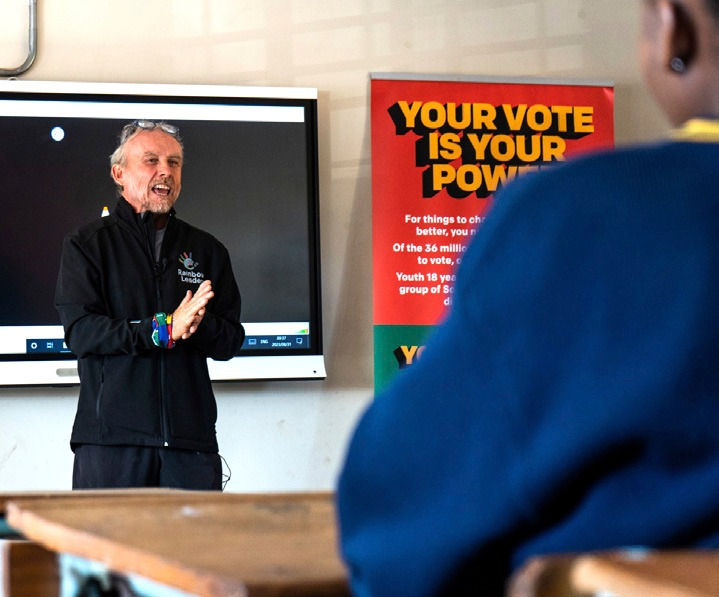
Along the way, we visited a number of schools to spread the message of just how crucial the youth vote is if we are to elect great leaders. We also did posts on social media almost daily, drawing followers into the journey, and the story behind it.
What did you learn about yourself, and about the people of Africa, on this mammoth odyssey?
The most prevalent observation from the expedition was sparked by a farmer in the Free State as he tried to rationalise why elected leaders in his province were so distracted from the work of fixing potholes in the roads so that the trucks could get produce to market. He noted that, instead of focusing on the simple matter of the potholes, during years of discussions the politicians seemed more interested in what socioeconomic events over the last 100 years might have led to the potholes appearing, and how under socialism there may be less potholes… The farmer quoted a social observer who said that "an idea is something that you have, whilst an Ideology is something that has you". Genius.
I observed how so many communities on my journey were stuck in the old way of doing things, or being in things that no longer served them. In fact, old ideologies and customs – often gender-based, and/or religiously centred – are holding communities back from making progress.
You've recently published a memoir called Running Africa about the journey and have plans to create a documentary in the future. How do you hope these media will encourage young Africans to participate in democracy?If a 58-year-old, overweight weekend warrior, with a genetic heart condition, can break a 26-year-old Guinness World Record for arguably the toughest run on earth, just imagine what we could do – together. We can eradicate unemployment and poverty within 20 years if we grow our economy a mere 2% more than our population, per year. That would make our economy 50% larger in real terms, creating 97% of the jobs we need, and yielding R1 trillion more in taxes every year, for spending on social issues such as health, education, policing and pensions. It really is that simple. But we have to get up and vote for great leaders if we want to achieve this.